

Dr. Bob: The Man and the Physician
It is very difficult to speak of Dr. Bob without going into eulogistic superlatives. While he lived, he laughed them off. And now, though he is dead, I feel that he still laughs them off. I sat beside him many times at the speakers' table and watched him squirm as some florid introduction was being given him. Many a chairman of the meeting strove to rise to the responsibility of introducing him by referring to him as co-founder of the "greatest, most wonderful, most magnificent, most momentous movement of all time." Dr. Bob whispered to me on one of these occasions, "The speaker certainly takes in a lot of territory and plenty of time."
While Dr. Bob thoroughly appreciated the spirit of personal gratitude that usually prompted such superlatives, he never took them seriously as applicable to himself. He rose up to tell with all humility the simple story of an alcoholic's return to sobriety. He seldom called upon his vast experience with others. He simply repeated in different ways the story of one man's great return. And that was his own.
He could have gone scientific and statistical, for he heard more confessions of sprees and lost weekends than anyone else alive. But he never did it that way. He always remained plain. Dr. Bob had once been lost in an alcoholic fog himself. He recalled that he, too, had been proud, resentful, full of rancor, cocky, self-sufficient, and selfish. But whether he spoke at the banquet table or ministered to an alcoholic in the ward, he was kind but firm, serious and sympathetic, always unmindful of race, color, creed, or previous state of alcoholic servitude.
Dr. Bob was a humble man. His humility was born, no doubt, of his humiliations before his good wife, Anne, and his colleagues in the medical profession. This led to the great step of becoming humble before his God. Here was the crisis in his life: at last, he found the God who he knew would help him if he would only place a humble confidence in him. This is the story of Dr. Bob. It is the story, too, of the Twelve Steps that logically follow, once the situation is faced with honest realism.
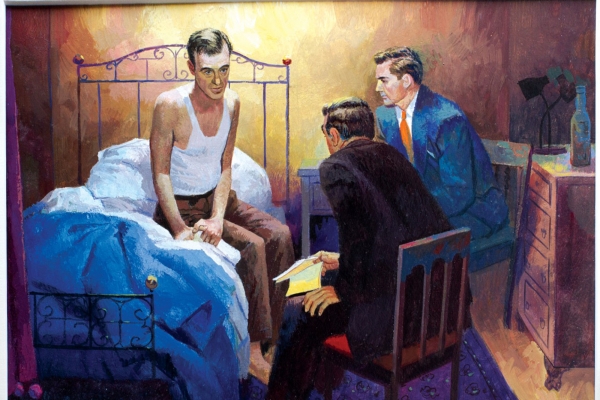
Looking back over his life, one might say Dr. Bob was two people, two personalities, even in his drinking days. After his return to sobriety, he still remained two personalities. As he made his rounds through St. Thomas Hospital, he did so as Dr. R. H. S., medical practitioner. But as he came to Room 390, the alcoholic ward, he put off the cloak of science and professionalism and became just plain Dr. Bob, a man eager, willing, and able to help his fellow man. As he left the hospital each day, two men went out through the door--one a great M.D., the other a great man.
It was quite natural that Dr. S. sought hospitalization for alcoholics. He had been sending the sick to St. Thomas Hospital for years, and alcoholism to him was a sickness as real as pneumonia, but not so easy to treat. The new treatment was to be physical, psychological, social, and spiritual. The whole patient was to be treated, because the whole man was sick.
Many of his colleagues in the medical profession disagreed with Dr. S., some bitterly. It was fortunate that he had been associated with the nursing sisters at St. Thomas Hospital. It was very fortunate, even providential, that he met the Sisters of Charity of St. Augustine. For in the long, long history of their order, they had taken care of all manner of disease, dereliction, and misfortune, and they were now willing to try the newer method of treating alcoholism. Thus, for the first time, a ward in a general hospital was opened to Alcoholics Anonymous.
Dr. S. and the sisters soon learned to diagnose more accurately and prescribe more effectively. Here was new type of patient needing a new type of treatment. The disorder seemed more on the psychological and spiritual than on the physical side. Here was a patient whose thinking was all beclouded; whose attitudes were wrong; whose philosophy of life was all mixed up; whose sense of values was distorted; whose spiritual life was nonexistent. The patient was indeed a definite challenge to the skill, patience, and prayer of all who worked at the hospital with Dr. S. in the noble art of healing a terribly wounded personality.
What success attended his efforts, as well as the efforts of the sisters and all who worked with the many patients who passed through that ward, is now a matter of history. It will ever remain a monument to the memory of R. H. S., M. D.--and Dr. Bob, the man.
CHRONOLOGY OF DR. BOB'S LIFE AND WORK
1879 Augut 9: Rober Holbook S. is born in St. Johnsbury, Vermont
1898 Graduates from St. Johnsbury Academy
1902 Graduates from Dartmouth College, Hanover, New Hampshire
1910 Obtains M.D. degree at Rush University, Chicago, Illinois
1912 Starts medical practice in Akron, Ohio
1915 January 25: Marries Anne Ripley
1933 Begins attending meetings of the Oxford Group
1935 May 12: Meets Bill W. at Henrietta Seiberling's home in Akron, Ohio
June 10: Dr. Bob has his last drink and AA is born
1937 AAs agree on need to publish a book about their solution to alcoholism
1939 April: Alcoholics Anonymous (the Big Book) is published
August: Dr. Bob and Sister Ignatia begin treating alcoholics at St. Thomas Hospital
November - December: Akron AAs break away from Oxford Group and begin meeting at Dr. Bob's house
1948 Summer: Is diagnosed with cancer; retires from practice
December: Gives last major talk, in Detroit, Michigan
1949 June 1: Anne Ripley S. dies
1950 July 28-30: Attends first AA International Convention, in Cleveland, Ohio, where he makes last appearance at large AA gathering and joins others in approving Twelve Traditions
November 16: Dr. Bob dies in Akron, Ohio