

Clubhouse for Drunks!
ON June 18, 1940, the cryptic letters 'AA' went up on a battered green doorway in the undistinguished neighborhood of New York's once elegant Chelsea district. It wasn't a very auspicious doorway, nor a conspicuous sign.
Nevertheless, on that memorable day New York laid claim to its only AA 'shrine.' And drunks, being wonderful hurry-up guys who think nothing of telescoping time, have, in less than eleven years, endowed it with layers of sentiment and tradition such as no ordinary institution could acquire in a century.
The now famous 'Twenty-fourth Street Clubhouse' is still actively in the AA orbit. After serving as 'General Headquarters' for the entire metropolitan area for four and a half years it was taken over, in December 1944, by the Seamen's group. Today, renamed the Helmsmen's Club, refurbished and made infinitely more attractive than it used to be, it still serves the seafaring drunks who seek the AA way of life.
Just mention to a New York old timer "Twenty-fourth Street" and watch his eyes light up. The affection in which so many hold the place is not for its good points but, as is the case with human beings, for its frailties.
The funny entrance, so difficult to find, is marked by its cockeyed address--334 1/2! Wedged in between two old-fashioned brick-fronts, the '1/2' number confirms the fact that there wasn't supposed to be any doorway there at all. Let's pretend that you are weaving your uncertain way along 24th Street looking for an address which your common sense tells you doesn't exist. Like so many others before and since, you do find the place. With shaking hand you push open the door. You're in a little vestibule and, if you're like most of us, you hesitate. . .that final split second of indecision, shall I go in, or shall I go back for one more drink?
Onward! you say. And you open the inner door to find--nothing! Nothing, that is, except a long, bare, tunnel-like and mysterious looking hallway. Leading to what?
Actually this is merely the passageway between the two houses back to the oddity of an 'extra building' built in the rear, over what had once been the 'gardens.'
It was Bill who first christened this hall 'The Last Mile'--and hundreds of us who since have reluctantly trod its forbidding length agreed that it was, in truth, a lot like walking the corridor of doom.
You too are scared a little as you journey the full length of 'The Last Mile. 'But ultimately you step into the inner sanctum which, on first sight, has been a lot of things to a lot of people, friendly, humble, quiet, restful--and somehow a little frightening.
This was the 'meeting room.' An old upright piano, a card table or two, a few nondescript chairs and, of course, people. But the center of the room to your newcomer's eye was the fireplace, pine panelled, with a plain wooden mantel and, over it. . .the first time you ever saw it. . .the sign reading--"But For The Grace of God. . ."
On the second floor there was another room of about the same size only somewhat lighter and airier, because of the skylight. Here, in addition to the secretary's desk, was what was called. . .grandly. . .'the lounge'. . .two wicker divans, three chairs and a table!
Off in the far corner was a door leading to two tiny rooms that had been Lois' and Bill's living quarters during a period when AA's financial affairs could easily be kept on the back of an old envelope. Today only Bill's room remains. . .and he still sleeps in it once or twice a week.
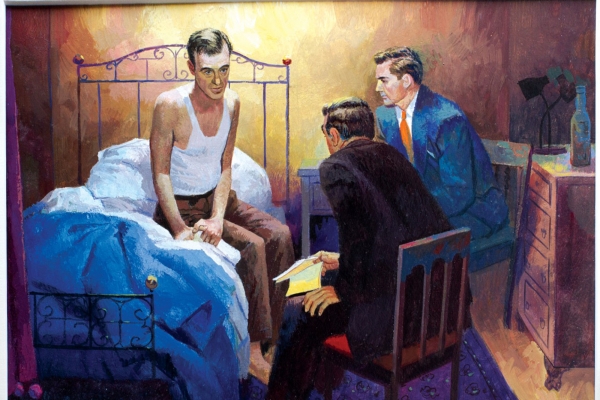
Here, on the second floor, you were first introduced to the AA program. Here you sat and shook out your hangover--and your old way of life.
You went to your first meetings in the 'inner sanctum' on the floor below. You felt an almost pitiful attachment to the strange assortment of people you met there. You soon knew them all not only by their first names but by the grim details of their lives--wrecked careers, broken homes, jail, hospitals, violence, and heartbreak.
You were there when Jack Alexander's article broke in the Saturday Evening Post in March, 1941. You heard the phones ringing incessantly; you did your share.
You were too damned busy to think much about your own problems. But, one day, it suddenly dawned on you that you were in the midst of something pretty wonderful. And you looked around you and began to realize what this funny place, these two dingy rooms, had come to mean to so many. And, because you could afford to feel a little sentimental again. . .you might have said to your self. . ."Why, G--damnit! I love this place. . ."