

I Laughed, He Laughed
Delmar had a Southern Georgia drawl like nobody else. He used to say, “alky-holic.” He was a big man with a big smile and a mischievous twinkle in his eye, along with a hearty laugh. He loved AA and he did as much Twelfth Step work as anyone I have known in the program. As he put it, he was “out chasing drunks most nights.” In addition to his day job as a construction engineer, he ran an aftercare program for a large treatment outfit. His energy was boundless.
Delmar was my first sponsor. He sponsored a lot of men. I asked him to help me because he was friendly and always laughing and he was one of the regulars of my group. He just smiled when I asked him and said, “Call me tomorrow.”
I did. And I quickly learned that he was serious about the Steps and serious about service work. At the same time, he did not push. If I was serious, fine. If I did not follow his “suggestions,” that was fine too. He had other men to work with and other things to do.
At the end of the meeting after I asked him to sponsor me, he said, “We’re going to wash ashtrays.” Cigarette smoke used to hang in layers at our meetings. There were a lot of ashtrays to collect off the tables, wash and put up. As we did that nasty chore, we talked. Sometimes I talked and he listened. Sometimes I asked questions I was too shy to bring up in the meeting and he answered. Sometimes we just talked. That was precious time.
The end of the month rolled around and Delmar said, “We’re going to the district GSR breakfast this Sunday.” That’s where I met folks from our area. Then when January came, he announced, “We’re going to the state assembly next Saturday and Sunday.”
I was one bewildered member in that sea of faces, but I began to learn how this thing we call AA is put together. At the end of what seemed an interminable stretch of time, I finally got my 90-day chip. That’s when Delmar’s directions changed. “You’re going to chair the meetings next month,” he told me. But he was right there at my elbow to help me out.
Delmar taught me the most important lesson about being married that a few marriage therapists missed: “One person cannot have an argument.” That was, and still is, absolutely profound.
He taught me about prayer. Early on, I heard him speak at our group. He shared about coming home early from work and finding his wife on her knees in their living room praying. He was shocked. “What if our neighbors saw you like that?” he asked. Her response was to the point. “What better way would I want them to see me than on my knees praying?”
I was praying by that time. Still, it took me a while longer to hit my knees. “Boy, the only thing you need to know about God is that there is one and you ain’t him,” Delmar would say. Later, when I complained and complained some more about my job and my boss and my life, he told me, “Turn in your ‘God card.’” He had to tell me that several times. Surrender was a hard concept for me.
The first time I heard Delmar’s story was at our home group. He grew up very poor and he had been through some difficult experiences. Despite that, he had gotten an education and he was married and had two sons. Then his oldest was killed in a car wreck late one night. Many of us in the room had no idea what he had gone through and what he lived with daily. Here was an affable, friendly man who was always smiling and laughing and telling stories, generous with his time and his help. He did not seem to have a problem in the world.
Today, I know that every alcoholic who makes it to AA has seen some heartache, but I was stunned when I heard Delmar speak that night. He knew about pain. He understood.
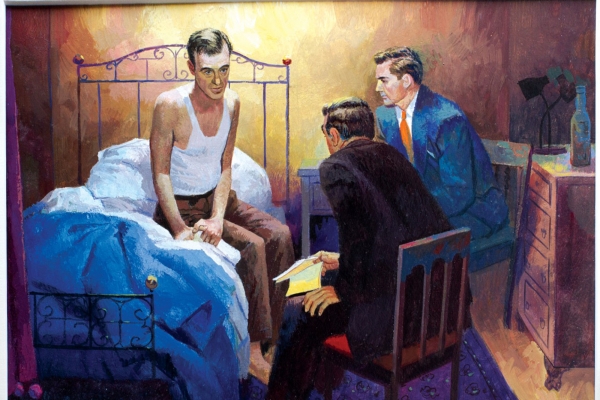
Delmar called the Fourth Step “taking out the garbage.” I was five months into sobriety before I was willing to do one. He gave me instructions and I went home and prayed and wrote. I did that each day after work for about a week. Finally, when I was done, I called him and went over to his house. We sat in his back yard under the trees. After we prayed together, I read him that mess, every bit of it. It took a while, but he did me the favor of staying awake. And he did not throw me out of his yard.
I heard a speaker at an AA Roundup one time tell the crowd that a Fourth Step was “not a list of filthy, nasty things.” My first one was a list of filthy, nasty things. But Delmar was unfazed. He shared a few things himself and we even laughed a little. Then he sent me home to think about what I had just done for the past hour.
Was I relieved, but spiritually lightened? No, I was just glad it was over. But something in me had changed that afternoon under the trees in his yard.
Delmar also taught me the importance of sticking with it. At almost five years sober, I was doing well. Life was good and busy. My family loved me, my job was good, and I was sober. I just didn’t come around my home group or the meetings very much. I had not seen Delmar in weeks. Then one morning, as I got ready for work, I realized that I hated everything and everyone. I was “restless, irritable, and discontented” for no good reason whatsoever. I called Delmar.
He met me for lunch at a fried chicken joint on the southside of town. He was sitting over on the side. When I got my tray and came over, he did not even give me time enough to sit down. “How many meetings are you making each week?” he asked. “And when was the last time you did a Fourth and Fifth Step?”
I laughed sheepishly, and he laughed, and I sat down and ate my chicken. Then I rejoined the AA program and became involved with my home group. I wrote a second Fourth Step and saw Delmar for the Fifth again.
Not long after that, Delmar retired from working road construction for the state and moved to another town. I still saw him at workshops, Intergroup, the state assembly and our annual Roundup, which he helped start. Eventually I got another sponsor. Delmar had developed breathing problems from all the road work he supervised. He stayed as active as he could for as long as he could.
The last time I saw Delmar was at his AA birthday. A friend called and asked me to speak. I was honored and scared I would say something stupid.
In that small clubhouse, Delmar sat at a table so close to the front I literally reached across and shook his hand when I got up to speak. I have no idea, of course, what I said, but even on oxygen, he laughed a lot.
When I finished, he hugged me, and I told him that I loved him. I still do. He died a few months later.
What do you owe your sponsor? What do I owe mine? In a very real sense, my life. Because of that man my life has been a very good one.
Need help with customer service?
Call 800 631-6025 (English), 800 640-8781 (Spanish), 212-870-3456 (French) or email: [email protected]
or [email protected]